Xianglian GI Protection: What the 34-Township Rule Actually Requires
"Xianglian" is not a generic word for lotus seeds grown anywhere in Hunan. It is a protected geographical indication with a defined territory, a named authorising authority, and a list of enterprises permitted to print the mark. Buyers who treat it as a synonym for "Chinese lotus seed" end up paying for a story they cannot substantiate on their own packaging.
Key takeaways
- 1.Protection was approved by AQSIQ in Announcement No.54 of 2010, and the certification trademark was registered in 2009 — two separate instruments.
- 2.The protected area is Xiangtan County in full, plus named townships of Shaoshan, Xiangxiang, Zhuzhou and Hengdong — 34 townships in total.
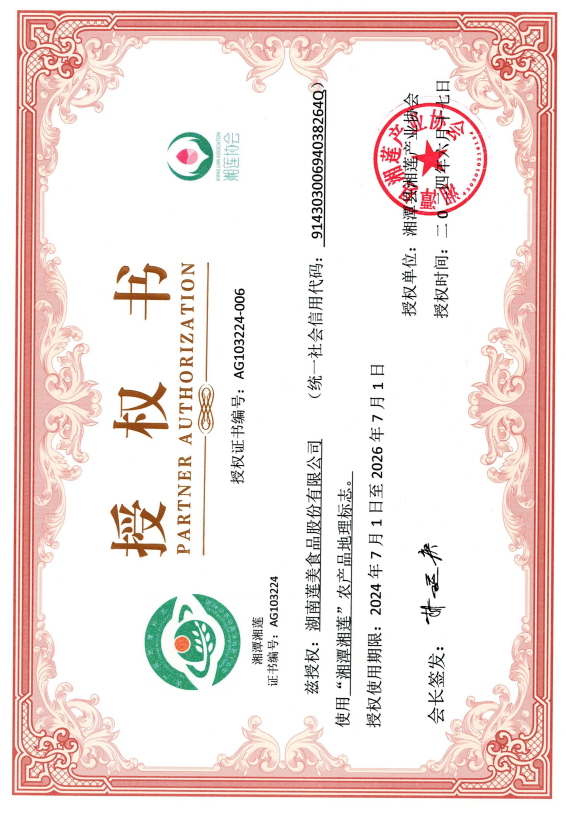
- 3.Only producers inside that area, authorised by the Xiangtan quality authority, may apply to use the GI special mark.
- 4.The authorised testing body is designated by the provincial bureau — a supplier's self-issued lab sheet is not a substitute.
- 5.In 2025 the county reported nine enterprises with GI special-mark authorisation and 27 with certification-trademark licence filings.
Two instruments, not one
China protects regional product names through two parallel systems, and Xianglian sits in both. The first is geographical indication product protection, administered historically by the General Administration of Quality Supervision, Inspection and Quarantine (AQSIQ). The second is the geographical indication certification trademark, administered by the trademark authority. They have different application routes, different rights holders and different marks on the pack.
For Xianglian specifically: AQSIQ announced GI product protection in Announcement No.54, dated 24 May 2010 and published on 2 June 2010, alongside Longquan Lingzhi, Pingdu peanut, Qinghai cordyceps and Tongxin jujube. The GI certification trademark was registered a year earlier, in 2009 — a fact the Xiangtan County government restates in its 2025 reply to a county people's congress suggestion.
Note: Practical consequence: a pack may carry one mark, the other, or both. Seeing only one is not automatically a defect — but the number on the mark should be traceable to a named holder.
What the 34 townships actually cover
The announcement text is unusually specific for a GI document, listing the territory township by township. Xiangtan County contributes all of its townships. Shaoshan contributes Yintian, Yongyi, Ruyi and Shaoshan townships. Xiangxiang contributes Meilinqiao, Dongjiao, Longdong, Lishan, Zhongsha and Shanazao. Zhuzhou's Hetang district contributes Mingzhao, and Hengdong county in Hengyang contributes Bailian.
This matters for buyers because the territory is what makes the name defensible. If your supplier's factory sits outside those townships but their packing house is inside, they are a processor of GI-area goods, not a GI-area producer in the strict sense. That distinction rarely affects product quality, but it does affect what claims can be printed on a retail pack in the destination market.
| Jurisdiction | Townships inside the GI area | Share of area |
|---|---|---|
| Xiangtan County | All townships | Majority of the protected area |
| Shaoshan City | Yintian, Yongyi, Ruyi, Shaoshan | Partial |
| Xiangxiang City | Meilinqiao, Dongjiao, Longdong, Lishan, Zhongsha, Shanazao | Partial |
| Zhuzhou, Hetang district | Mingzhao | Partial |
| Hengyang, Hengdong county | Bailian | Partial |
Who can use the mark, and who merely mentions the name
The announcement sets a procedural gate: producers within the protected area may apply to the Xiangtan municipal quality and technical supervision bureau, the application is reviewed by the Hunan provincial bureau, and use of the mark is approved by AQSIQ announcement. The statutory testing body is designated by the provincial bureau. In other words, authorisation is not self-declared.
In its 2025 filing the county reported nine enterprises holding GI special-mark authorisation and 27 with certification-trademark licence filings, plus an application to the provincial bureau to consolidate seven enterprises from the 「湘潭湘莲」 agricultural GI user list into the 「湘莲」 GI product mark list. Two GI systems for the same product, being merged — a detail worth knowing if you are reviewing older supplier paperwork.
Note: A trader can lawfully sell GI goods without holding GI authorisation. What they cannot do is present themselves as the authorised producer. Ask separately: who produced, who is authorised, who is exporting.
The five-year enforcement record
County market supervision has run recurring special enforcement against unauthorised use, counterfeiting and forgery of the GI mark, and against unfair competition around the name. That enforcement is the reason a GI claim has commercial value: it is backed by someone actually policing it.
On the institutional side, the Xianglian provincial GI protection demonstration zone was approved for establishment in July 2022, formally inaugurated in May 2023, and passed provincial acceptance in March 2025 with an 「优秀」 (excellent) rating — the first such zone in Xiangtan. For a buyer, this is a signal about administrative attention rather than about product quality directly.
A document checklist for first orders
- 1Ask for the GI special-mark authorisation or the certification-trademark licence record, with the enterprise name matching the invoice issuer.
- 2Confirm the production address falls inside one of the 34 townships; check the address on the business licence, not the sales office address.
- 3Request a batch certificate of analysis from a testing body acceptable to your destination market, and check whether the statutory body designated by the provincial bureau was used.
- 4Photograph the pack artwork and mark placement before production, and keep the approval trail — retrofitting a mark onto printed packaging is where compliance problems start.
- 5For retail in the destination market, check separately whether your own label may reference the GI name; that is governed by local labelling law, not by Chinese GI rules.
Common misreadings
First misreading: that GI status certifies quality. It certifies origin and process conformity to a published technical requirement. A GI-compliant lot can still be last season's crop or badly stored.
Second misreading: that GI status is export permission. It is not. Export admission is a separate matter of the destination country's food import rules, phytosanitary requirements and labelling law.
Third misreading: that the GI area boundary equals the sourcing boundary in practice. Traders routinely blend GI-area and non-GI-area seed. If origin integrity matters to your product claim, specify segregation and ask for lot traceability.
Grades, limits, tax treatment and inspection regimes change without notice. Confirm the current position for your product, origin and destination with your importer or the relevant authority before contracting — treat everything here as a starting point for verification.
Frequently asked questions
QWhen did Xianglian receive GI protection?
QCan lotus seeds grown outside the 34 townships be sold as Xianglian?
QDoes GI authorisation guarantee export registration?
QWhat is the difference between 「湘莲」 and 「湘潭湘莲」?
QHow can I tell a real GI mark from a printed logo?
Products referenced in this guide
Continue reading
Need this turned into a quotation?
Send the destination market, the end product and the volume. You get back a grade specification, a testing plan and a document list — the same three things this article told you to ask for.
Request a quote